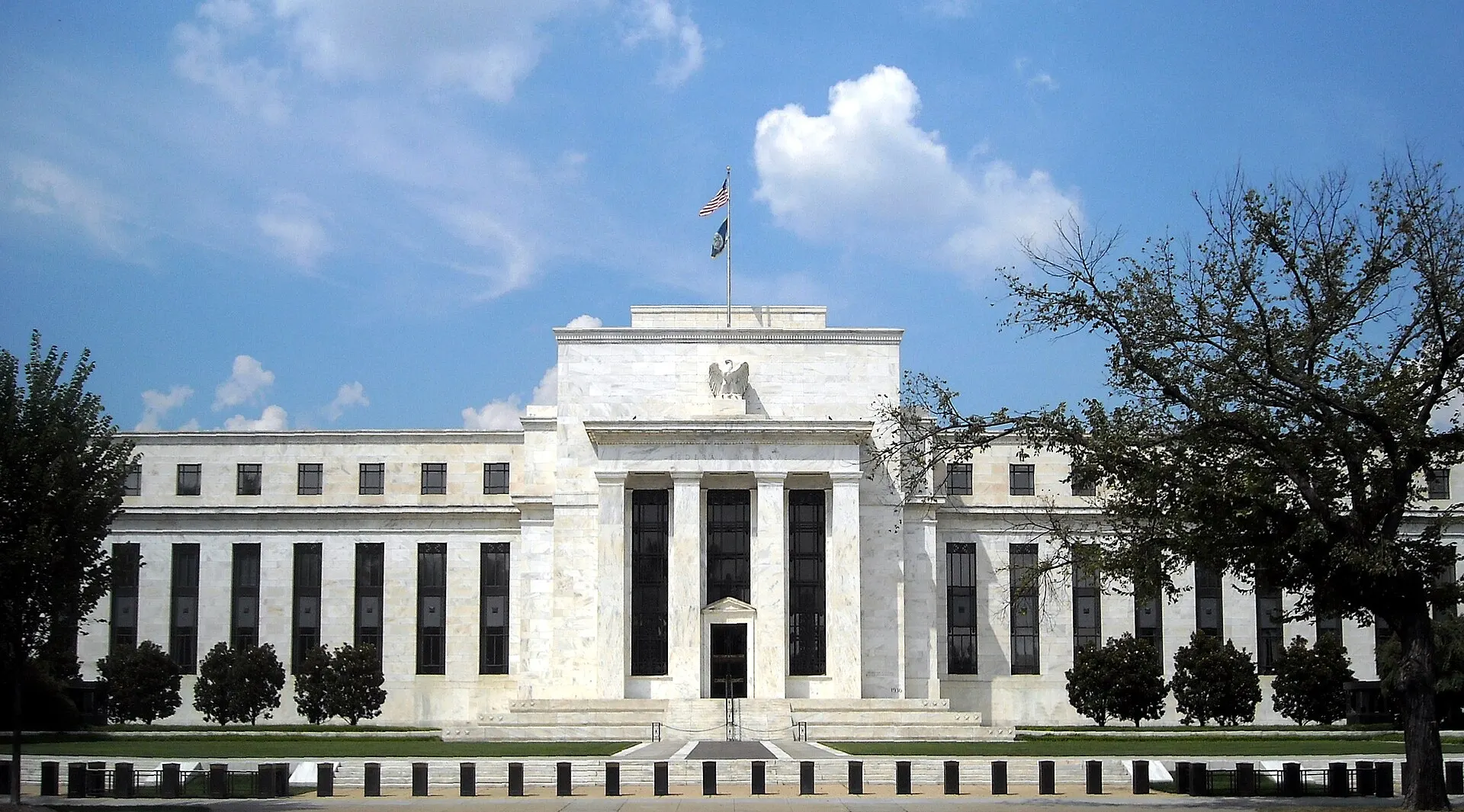
WASHINGTON — The Federal Reserve left its benchmark interest rate unchanged at a range of 3.75% to 4% on Wednesday, but two of the 12 voters on its rate-setting committee broke ranks and argued for a quarter-point increase instead.
The Federal Open Market Committee voted 10-2 to hold. Governor Lisa Cook and Cleveland Fed President Beth Hammack both wanted rates higher. The decision came six days before the US midterm elections and leaves the rate where it has sat since the committee raised it by a quarter point in September, its first increase in more than three years.
What the Fed does with the dollar sets the price of credit in the UAE, where the dirham is pegged to it. The Central Bank of the UAE said on Wednesday that it would keep its own base rate at 3.9%, the rate paid on overnight deposit facilities, after the Fed's decision.
That rate tracks the Fed's interest on reserve balances, and the central bank said it signals policy and keeps overnight money market rates in the country from falling below it. It also kept the rate charged on short-term liquidity borrowing through its credit facilities at 50 basis points above the base rate, or 4.4%, according to Gulf News. The CBUAE raised the base rate to 3.9% after the Fed's September increase, Gulf News reported.
Inflation "remains elevated", the Fed's post-meeting statement said. "The accumulation of more information will help the Committee determine the policy stance appropriate to ensure a timely return of inflation to the Committee's 2 percent goal. The Committee will deliver price stability."
The committee also upgraded its description of economic activity, from "solid" in September to expanding at a strong pace. The only other substantial change, CNBC reported, was the deletion of a sentence explaining the September increase.
The split vote was unusual in its make-up. It was the first time since October 1992 that a Fed governor and a regional bank president dissented on the same side, Fortune reported. On that occasion Governor Lawrence Lindsey and Cleveland Fed President Jerry Jordan both wanted an immediate cut.
It was also Cook's first dissent since she joined the Board in 2022 as an appointee of President Joe Biden. She remains at the centre of President Donald Trump's effort to remove her from the Fed, which the administration has revived with a hearing set for early November, CNBC reported.
Asked whether the proximity of the November 3 elections had shaped the vote, Chair Kevin Warsh said politics played no role and that neither politics nor the election was discussed at the meeting. He declined to answer criticism from Trump, who nominated him and has said the funds rate should be far lower.
"The overwhelming consensus is that what we've done in this monetary medicine is starting to work some," Warsh told reporters, adding that there were "no firm conclusions".
Warsh said inflation had run above the committee's objective for close to six years and that there is "no soft inflation target and no implicit inflation target", with 2% measured by the personal consumption expenditures price index. He called the labour market "quite positive" and said financial conditions had tightened for some businesses and households, though he was "unwilling and unable to call them tight".
The data he is weighing point in opposite directions. Consumer prices rose 3.7% in the year to September, according to Labor Department data. Core inflation on the Fed's preferred gauge, which strips out food and energy, is expected to come in above 3% for the same month, according to CNBC. At the same time the Atlanta Fed's GDPNow tracker points to 3.4% annualised growth in the third quarter, which would be the strongest in a year.
Two other officials who dissented at the July meeting, Dallas Fed President Lorie Logan and Minneapolis Fed President Neel Kashkari, voted with the majority this time.
Warsh also used the news conference to change how the committee will meet. "We believe eight meetings per year is the right number for the FOMC, but in 2027, one meeting will focus exclusively on broad monetary policy strategy, with neither a vote on the federal funds rate nor a policy statement anticipated," he said.
"The rest will be regular FOMC policy setting meetings, and I expect that in 2028 we'll have two meetings dedicated discussions of strategy and six for setting policy," he added. The effect is to cut the number of scheduled rate decisions from eight a year to seven in 2027 and six in 2028.
Markets took the hold calmly. The S&P 500 rose 0.26%, the Dow Jones Industrial Average 0.28% and the Nasdaq Composite 0.17%, according to Fox Business. The yield on the 10-year Treasury note pushed above 5% during the afternoon, Yahoo Finance reported, with the 30-year near 5.33%.
Traders moved further towards expecting a rise before the end of the year. The CME FedWatch tool put the odds of a quarter-point increase in December at 82.6% after the decision, up from 78.3% a day earlier, Fox Business said. Futures pricing compiled by Bloomberg implies a policy rate near 4.7% by September 2027, Yahoo Finance reported.
Warsh gave no guidance on what the committee will do next. It meets again on December 8-9.
Sources
- Fed holds rates steady despite concerns over inflation (CNBC) (cnbc.com)
- October FOMC: Federal Reserve holds rates steady ahead of election (Fox Business) (foxbusiness.com)
- Fed meeting live updates: Interest rates held steady in split vote (Yahoo Finance) (ca.finance.yahoo.com)
- Fed holds rates steady as a governor and president dissent together for the first time since 1992 (Fortune) (fortune.com)
- UAE keeps key interest rate unchanged in October, mirroring US Fed move (Gulf News) (gulfnews.com)
This report was compiled from the publicly available reporting listed above. Direct quotations are reproduced as published by those outlets. Corrections: see our corrections policy.