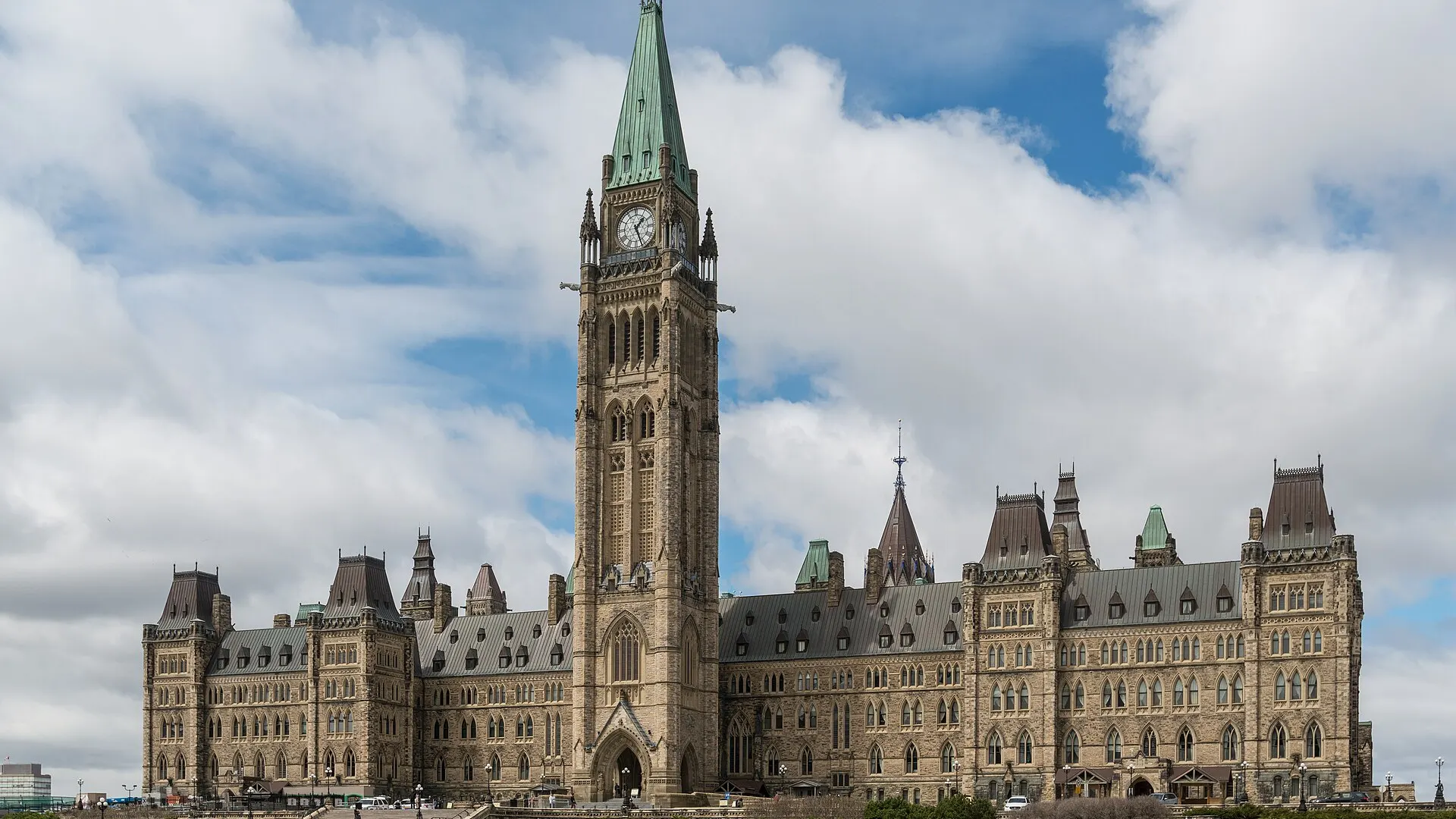
OTTAWA — Prime Minister Mark Carney welcomed Abu Dhabi's Crown Prince Sheikh Khaled bin Mohamed bin Zayed Al Nahyan to Parliament Hill on Tuesday, and the two governments launched a long-term strategic partnership built around a new free trade agreement and a $70 billion Emirati investment pledge.
It is the first visit to Canada by a crown prince of Abu Dhabi, Carney's office said. The partnership gives Ottawa and the Emirates a single framework for cooperation on economic ties, energy, technology, education, defence, diplomacy and cultural exchange.
Sheikh Khaled landed at Ottawa Macdonald-Cartier International Airport and was received by Foreign Minister Anita Anand, the Emirati state news agency WAM reported. Carney hosted a dinner in his honour in downtown Ottawa on Monday, where the prime minister said the two countries were united in their determination to "build for the future". The Globe and Mail, which obtained the invitation list, reported nearly 120 names on it, among them former prime minister Stephen Harper, Enbridge chief executive Gregory Ebel and André Desmarais, the deputy chairman of Power Corporation of Canada.
Ministers from both sides signed the Canada-UAE Comprehensive Economic Partnership Agreement, the Canadian government said. Talks took 47 days, which Ottawa called the fastest free trade negotiation either country has completed. Once the deal takes effect, which Ottawa expects in 2027, tariffs would be cut or removed on more than 99 per cent of current Canadian exports to the Emirates. International Trade Minister Maninder Sidhu said it would double two-way trade over the next decade, from $3.4 billion to $7 billion.
Canadian government figures put merchandise trade with the UAE at $3.5 billion last year, $2.8 billion of it exports, with Canadian sales up more than 10 per cent. More than 150 Canadian companies operate in the Emirates and about 60,000 Canadians live and work there, according to the release.
The readout of the leaders' meeting said they exchanged views on the Middle East, on maritime security and on international peace and security, and reaffirmed their commitment to dialogue, regional stability, open shipping lanes and multilateral cooperation.
Shipping in the Gulf has been under sustained attack. The Washington Institute for Near East Policy, which maintains a map of incidents in the area, has counted 28 confirmed or reported attacks in and around the Strait of Hormuz this month, a record, and 113 since the United States and Israel went to war with Iran on February 28, Al-Monitor reported. The strait runs past the UAE's northern coast.
Sheikh Khaled travelled with four ministers: Sultan Al Jaber, the minister of industry and advanced technology; Reem Al Hashimy, minister of state for international cooperation; Thani Al Zeyoudi, minister of foreign trade; and Mohamed Hassan Al Suwaidi, the investment minister. Sheikh Khalifa bin Tahnoon Al Nahyan, who chairs the Crown Prince's Court, was also on the guest list.
Several memorandums were signed alongside the trade deal. A defence cooperation document modernises an older arrangement and covers military education, training, joint exercises, defence industrial work and cyber security, and sets up a joint military committee. Global Affairs Canada signed a training agreement with the Anwar Gargash Diplomatic Academy in Abu Dhabi.
On the investment side, DP World signed a memorandum with Arctic Gateway Group and CentrePort Canada to develop a transport corridor linking the Port of Churchill on Hudson Bay, the Hudson Bay Railway and CentrePort in Manitoba. Masdar and Natural Resources Canada signed an energy cooperation arrangement. Invest in Canada and the Abu Dhabi Chamber of Commerce and Industry agreed to share information and coordinate visits. The two countries also said they would open negotiations on an extradition treaty and a mutual legal assistance treaty.
The $70 billion figure dates from Carney's own trip to the Emirates last November. In the release marking Tuesday's talks, he said the UAE had "turned a historic $70 billion commitment into real investments in Canadian energy, infrastructure, and technology". Sidhu said the money could flow into mining, logistics, energy and digital technology. "They are actively looking at deploying that as soon as possible," he said. "They'll have more to say publicly soon."
The visit fits Carney's effort to find customers and capital outside the United States while his government remains in a tariff dispute with Washington. Costanza Musu, a professor at the University of Ottawa, told CBC News the agreements showed that push to diversify trade and investment.
Asked about human rights concerns linked to the Emirates, Sidhu said "human rights never takes a back seat with Canada" and argued that staying at the table let Ottawa raise its concerns directly.
At the dinner the two sides discussed lifting relations and deepening the strategic partnership, The National reported. Sheikh Khaled thanked Carney for the welcome and hospitality shown to him and his delegation, and Carney said he hoped the visit would strengthen friendship and cooperation between the two countries.
Carney and Sheikh Khaled agreed to remain in close contact, the readout said. Neither government gave a date for the opening of the extradition and legal assistance talks, and Ottawa expects the trade agreement to take effect in 2027.
Sources
- Prime Minister Carney launches new Strategic Partnership with the UAE, welcomes landmark trade agreement and billions in investment (Prime Minister of Canada) (pm.gc.ca)
- Readout - Prime Minister Carney meets with Crown Prince of Abu Dhabi Sheikh Khaled bin Mohamed bin Zayed Al Nahyan (Prime Minister of Canada) (newswire.ca)
- Canada, U.A.E. sign defence, energy agreements during crown prince's visit (CBC News / The Canadian Press) (cbc.ca)
- Abu Dhabi Crown Prince arrives in Canada on official visit (Anadolu Agency) (aa.com.tr)
- Sheikh Khaled attends dinner hosted by Canada's PM during official visit (The National) (thenationalnews.com)
- Business leaders and Emirati officials on guest list for Carney's dinner with Abu Dhabi Crown Prince (The Globe and Mail) (theglobeandmail.com)
- Ship attacks in Strait of Hormuz hit record high in October (Al-Monitor) (al-monitor.com)
This report was compiled from the publicly available reporting listed above. Direct quotations are reproduced as published by those outlets. Corrections: see our corrections policy.