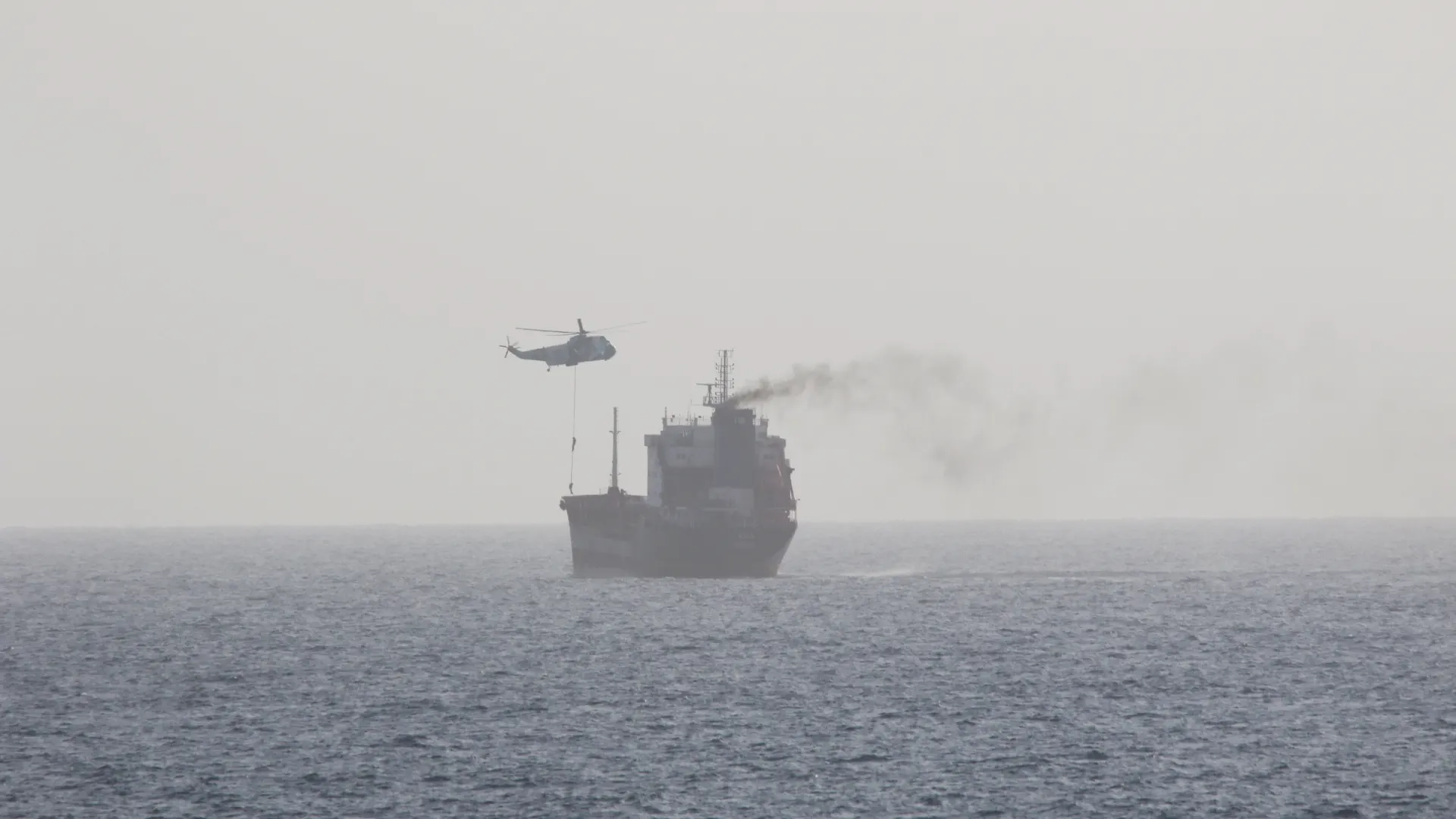
MUSCAT — Oman's navy took 25 crew off a burning Panamanian-flagged crude tanker in the Strait of Hormuz on Friday, hours after Iran's Revolutionary Guard Corps said oil tankers crossing the waterway had been stopped on a route Tehran calls unauthorised.
Oman's Maritime Security Centre said the navy had run an evacuation for the 25 crew of the RITI after the ship was targeted and caught fire. Those taken off were given medical care, the centre said, without giving further detail. The ship-tracking website MarineTraffic lists the RITI as a crude oil tanker.
The strait normally carries about a fifth of the world's oil, and it has become the central front of the war that began on February 28 with US and Israeli strikes on Iran. The British agency UK Maritime Trade Operations said on Friday that traffic through the channel was running about 70 per cent below pre-war levels. Brent crude closed at a six-month high.
Maritime sources told Reuters that Friday's attack was the first known successful use of limpet mines in the strait since the war started. A small boat came alongside a tanker to port about 25 nautical miles north-east of Khasab, Oman, and fixed two explosive devices to the hull above the waterline, UKMTO said. The blasts set off an engine-room fire and briefly disabled the ship. Reuters said it was not immediately clear who was behind the attack.
UKMTO later said the fire was out and the vessel was sailing on. The agency also reported a separate incident on Friday, saying a ship 40 nautical miles south of Iran's Lavan Island had been hit by an unknown projectile and caught fire. "The crew of the vessel have been reported as safe and there is no reported environmental impact at this time," UKMTO said on X.
The Revolutionary Guard gave a different account of the day. It said three oil tankers had been halted after encountering unspecified incidents or striking mines.
"Two offending oil tankers, one in the eastern part and the other in the western part of the Strait of Hormuz, which were attempting to pass through the unauthorised route, encountered incidents and were brought to a halt in the waters south of the strait," the Guard said. The tankers had "switched off all their navigation and positioning systems" and were attempting to leave by the unauthorised route "with the support of the terrorist U.S. military", the statement said. The vessels had ignored several radio warnings, the Guard said.
A later Guard statement said a supertanker carrying two million barrels of oil had stopped after an explosion caused by a naval mine on an unauthorised route. "This is the third oil tanker to have exploded and caught fire today as a result of attempting to pass through an unauthorised route," it said. Accounts differ: Al Jazeera reported Iran saying four tankers were halted, two of them exploding after striking mines. Iran's armed forces had said the previous day that at least four tankers stopped in the area after hitting mines. Iran's navy said separately on Friday that it had destroyed an unmanned craft east of the strait.
None of the Iranian mine claims has been independently verified.
The US military rejects them. Admiral Brad Cooper, head of US Central Command, said in a video released on Friday that American forces had "successfully cleared the strait's internationally recognised primary transit routes of Iranian sea mines" and remained "present to ensure that all primary transit routes in the Strait of Hormuz remain free and clear". He repeated that Washington has helped Gulf countries export more than 1.5 billion barrels of crude through the strait since the summer.
Hossein Mohebi, a spokesman for the Revolutionary Guard, said: "Prove the claim that the Strait of Hormuz has been cleared of mines with independent evidence, not a statement."
Iran has demanded that ships use a designated channel and coordinate their passage with its armed forces, treating a southern corridor closer to Oman's coast as off limits. It said last month that vessels transiting Hormuz without authorisation would face "destruction", Al Jazeera reported. Washington has answered Iran's blockade with a counterblockade of Iranian ports.
Oil markets closed the week higher. Brent crude for December delivery, which expired on Friday, settled up $2.76, or 2.4 per cent, at $117.64 a barrel after touching $118, its strongest finish since the end of April. The more active January contract rose $2.63 to $113.43. West Texas Intermediate settled $2.12 higher at $104.12. Brent gained 13.6 per cent over October and WTI 15.2 per cent.
"Traders will remain focused on oil flows out of the Middle East and the likely escalation by US and allied forces," said Dennis Kissler, senior vice president of trading at BOK Financial.
Diplomacy has continued in parallel. Vice President JD Vance sent a letter through Qatari mediators to Mohsen Rezaei, head of Iran's Supreme National Security Council, proposing a framework for talks. Asked whether he had ordered the outreach, President Donald Trump said no, describing it as Iran needing "help with medical supplies and various things".
The Wall Street Journal, citing unnamed US officials, reported that Cooper has briefed Trump on military options against Iran. US media have reported that the administration may resume military action in the region after the midterm elections on November 3, the next date traders and Gulf governments are watching.
Sources
- Oman rescues 25 from burning oil tanker in Strait of Hormuz (Al Jazeera) (aljazeera.com)
- Oman rescues 25 from burning ship, Iran halts tankers (AFP via The Hindu) (thehindu.com)
- Oil jumps 2pc (Reuters via Business Recorder) (brecorder.com)
- Iran claims four tankers struck mines in Hormuz as strike fears grow after U.S. midterms (CNBC) (cnbc.com)
- Brent Hits $117 as Tanker Catches Fire in Strait of Hormuz (Oilprice.com) (oilprice.com)
This report was compiled from the publicly available reporting listed above. Direct quotations are reproduced as published by those outlets. Corrections: see our corrections policy.