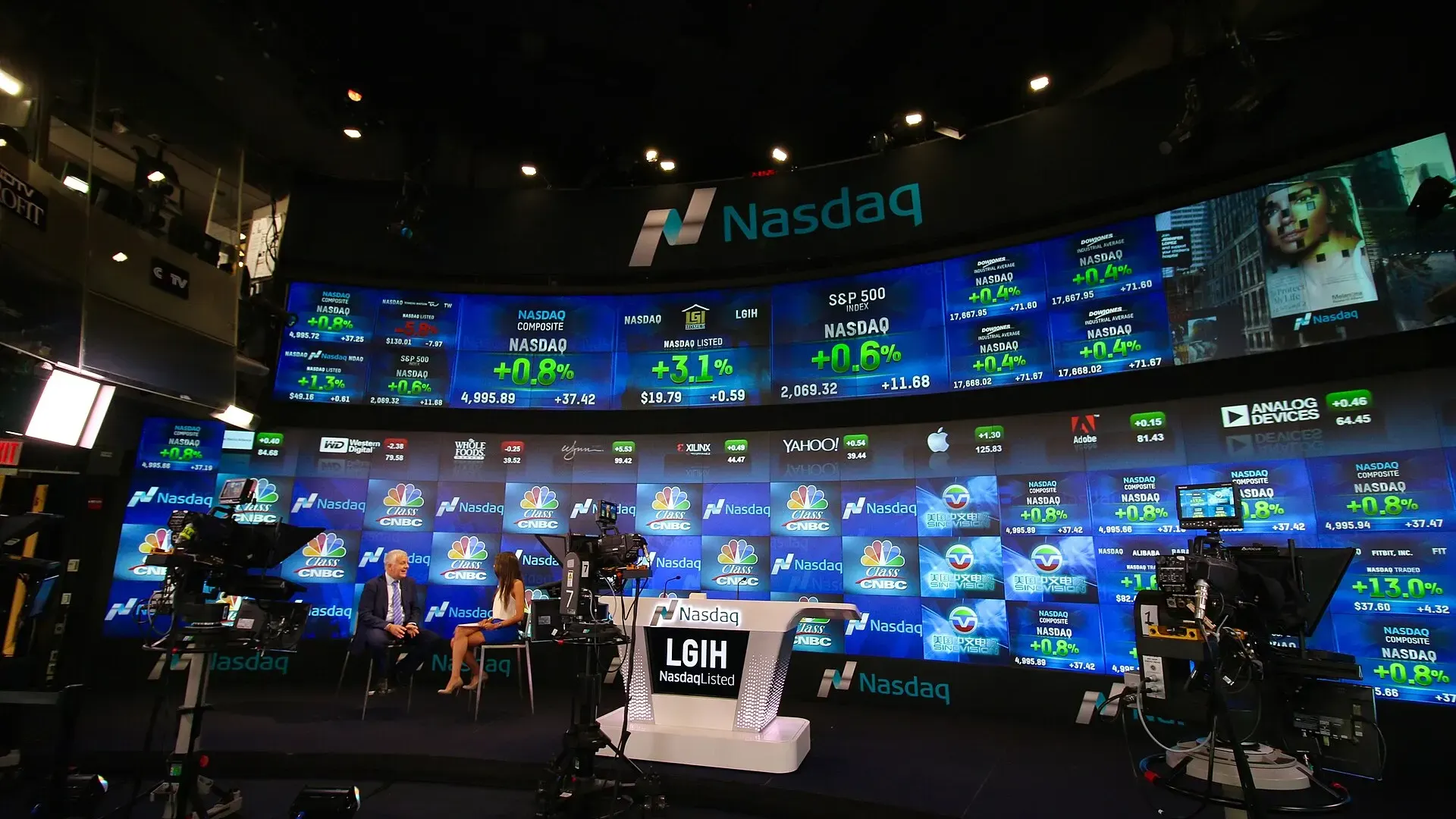
NEW YORK — The Nasdaq Composite fell 2.1% on Friday to close at 26,140.03, sealing its worst week since late June as a sell-off in semiconductor and artificial intelligence stocks stretched into an eighth straight session.
The Philadelphia Semiconductor Index dropped 3.8% on the day, its eighth consecutive decline and its longest losing streak since 2008, according to NBC News. The index lost 11.4% over the week, its worst weekly performance since early April 2025, Investing.com reported.
The slide is the sharpest test yet of the AI trade that has powered US equities for most of 2026. Investors who spent the year rewarding chipmakers and cloud providers for record spending on data centres are now asking how that spending is being financed and when it will pay off.
The S&P 500 lost about 1.1% on Friday to finish near 7,659 and ended the week down roughly 2%, its biggest weekly drop since June, Reuters reported. The Dow Jones Industrial Average slipped less than half a percent on Friday but still gained 0.7% for the week as money rotated into energy, utilities and financial shares.
The Nasdaq's 4.5% weekly loss ended a four-week winning streak. The Cboe Volatility Index briefly reached 22.31, its highest intraday level since June 11, according to Yahoo Finance.
Memory-chip makers led the losses. Micron fell 14.6% for the week, Samsung Electronics 17.8% and SK Hynix 24.3%, Investing.com reported, after reports early in the week of technical advances by China's ChangXin Memory Technologies. Broadcom dropped 4.5% on Friday alone.
CoreWeave, the AI cloud provider that carries about $50 billion in debt, fell 11.9% on Friday and nearly 25% over five days, according to Reuters and Capital Brief. Its bonds fell to new lows during the week, and Nvidia chief executive Jensen Huang said the company did not need a backstop, Investing.com reported.
"This is not about fundamentals," Tal Liani, an analyst at BofA Securities, said of the selling in CoreWeave, according to Yahoo Finance. He kept a Buy rating and a $140 price target on the stock.
The pressure spread beyond chips. Palantir fell about 7% on Friday, Salesforce, ServiceNow and Atlassian each lost more than 3%, and Twilio slid about 10%, Yahoo Finance reported. Tesla dropped about 2% after unveiling its new Roadster.
Nick Colas, co-founder of DataTrek Research, said investors are "burnt out on AI" and pointed to interest rates as the catalyst for the selling.
Rates are the second strand of the story. The consumer price index released on Wednesday showed inflation rose to 3.7% in September, hotter than economists expected, and the 10-year Treasury yield traded near 5.07% on Friday, according to Yahoo Finance. The Federal Reserve raised its benchmark rate by a quarter point in September to counter inflation driven by fuel costs, NBC News reported.
Fed Chair Kevin Warsh declined on Friday to say whether the central bank would raise rates again before the end of the year. "I don't prejudge meetings," he said. Futures markets put the odds of a hike at the Oct. 27-28 meeting at roughly 15%, down from about a third immediately after the inflation report, Yahoo Finance reported.
"Earnings are important, but the market is concerned that 2026 will mark the peak for earnings growth," Michael O'Rourke, chief market strategist at JonesTrading, said, according to Investing.com.
Oil added to the strain. Brent crude touched $110 a barrel for the first time since May and settled at $109.86, while US crude closed at $101.41, as Iranian attacks on shipping in the Strait of Hormuz and uncertainty over Russian diesel supplies pushed prices higher, Reuters reported.
Ed Yardeni of Yardeni Research cut his year-end target for the S&P 500 to 7,900 from 8,400, citing investor caution about AI alongside lingering concerns about inflation and rates, according to NBC News.
Not every strategist sees a turning point. Vivek Arya of BofA wrote that deployed AI infrastructure is running near full utilization and that rising GPU rental rates are "a sign of scarcity, not glut," adding, "We think the risk is priced in," according to Yahoo Finance.
"This is very much an on-off switch type of market," Garrett Melson, portfolio strategist at Natixis Investment Managers Solutions, told Reuters.
Despite the week's losses, the S&P 500 remains about 2% below the record high it set earlier this month and is up about 12% for the year, Reuters reported. The semiconductor index, even after a 12% drop in October, is still up 57% in 2026.
The focus now turns to third-quarter results. LSEG IBES expects S&P 500 companies to report earnings growth of more than 30%, according to Reuters. Meta Platforms reports next week, opening the season for the hyperscalers, with Lam Research and Texas Instruments due on Wednesday and Tesla, Netflix, Procter & Gamble and GE Aerospace also on the calendar.
Goldman Sachs estimates the five largest hyperscalers could lift capital spending to about $1.2 trillion next year, Reuters reported, a figure that will frame how investors judge each report.
Sources
- Stock market today: Dow, S&P 500, Nasdaq sink as tech sell-off caps volatile week (finance.yahoo.com)
- As AI rally wobbles, stock market's spotlight turns to earnings (Reuters) (investing.com)
- Tech stocks erase $1 trillion of wealth as oil surges to $110 for the first time since May (nbcnews.com)
- Nasdaq notches worst week since late June with a 4.5% slide as AI trade suffers (in.investing.com)
- Chip stocks drag Nasdaq to worst week since tariff turmoil (capitalbrief.com)
This report was compiled from the publicly available reporting listed above. Direct quotations are reproduced as published by those outlets. Corrections: see our corrections policy.