BEIJING — Nvidia shipped 678,000 artificial intelligence accelerators to China in the first half of 2026, 44% fewer than a year earlier, as Huawei and a group of domestic chipmakers took a growing share of the market, according to IDC data reported by Reuters on Tuesday.
The research firm put Nvidia's share of China's market for data-centre AI chips at 34% for January to June. Huawei, which shipped 572,000 units, up from more than 300,000 a year earlier, held 28%.
The figures offer a unit-by-unit measure of how US export controls and Beijing's drive for technological self-sufficiency are changing who supplies the computing power behind China's AI industry. They also show the market moving away from the type of chip on which Nvidia built its lead.
Shipments of graphics processing units, or GPUs, fell 26% to 991,000 units in the period, IDC said. Shipments of other AI accelerators rose nearly 80% to 1.016 million, overtaking GPUs by volume. Total shipments reached 2.008 million units.
GPUs were first designed to draw video-game graphics, but their ability to run thousands of calculations at once made them the chips most widely used to train AI models. The other accelerators in IDC's count are chips built for narrower jobs, such as running models that have already been trained, a task known as inference.
Huawei, Alibaba's chip unit T-Head, Baidu's Kunlunxin and Cambricon together accounted for 95% of that non-GPU segment, which IDC said was being adopted by government agencies, internet companies and telecoms providers.
Across the whole market, T-Head held 7%, Cambricon 5%, Kunlunxin 4% and Hygon 3%. Nine of the 11 Chinese chipmakers that IDC tracks shipped more chips than a year earlier.
South Korea's Aju Press, which also reported the IDC figures, said the gap between Nvidia and Huawei had narrowed to 6 percentage points from 35 points last year. It said the first half was the first time that non-GPU chips had outshipped GPUs in China.
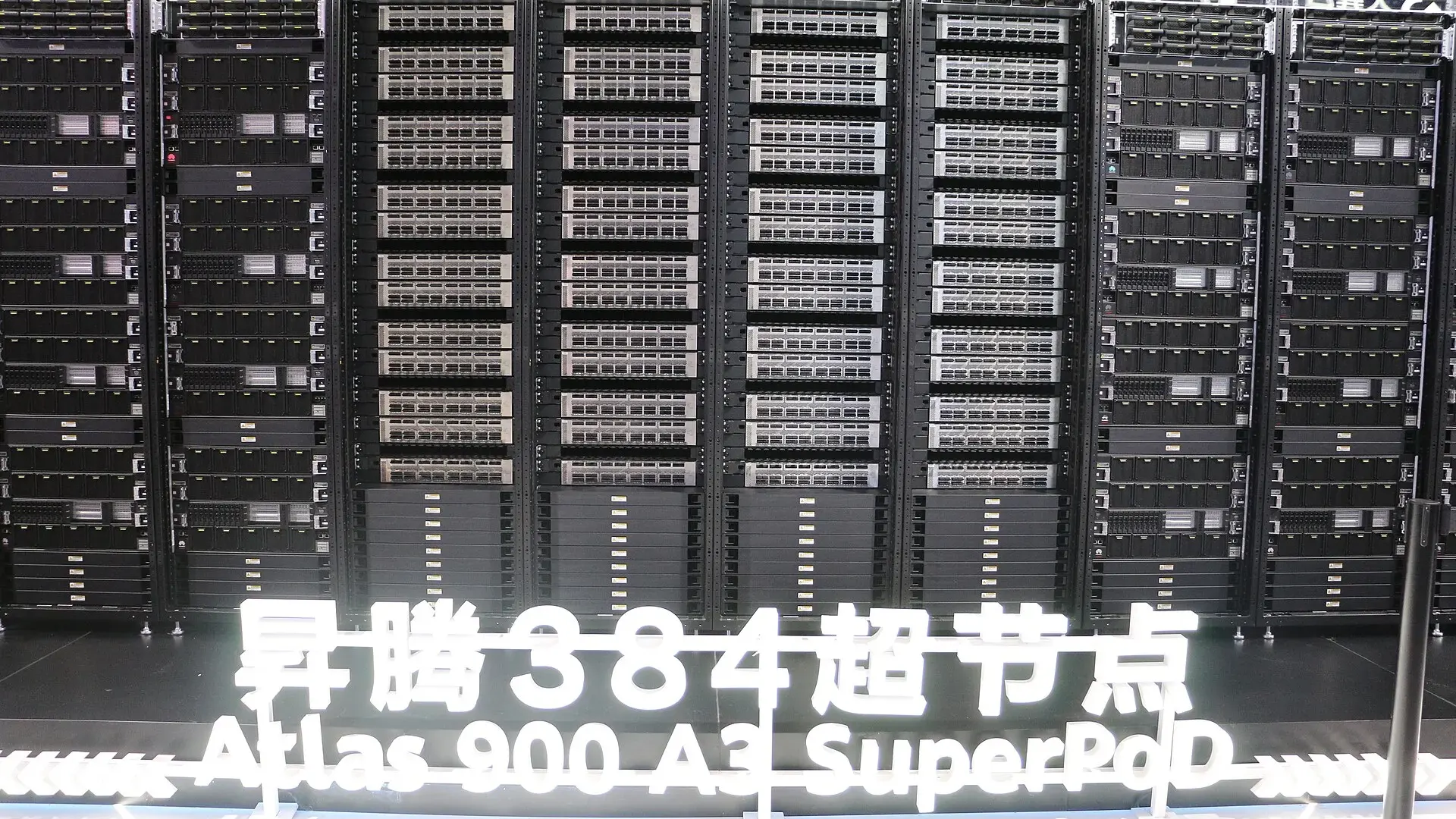
IDC said competition was shifting from the performance of a single chip toward system-level capability, including how well chips work together in a larger computing cluster. Huawei is trying to link hundreds of thousands of AI chips into one giant computer, TechCrunch reported in September.
At its Huawei Connect conference that month, the company said its Atlas 950 SuperCluster could connect up to 256,000 accelerator cards. Huawei builds such systems on UnifiedBus, its own interconnect technology, which ties processors to memory, storage and networking hardware.
Not everyone has taken Huawei's plans at face value. Rui Ma, a China technology analyst, wrote on X that the company had earlier said its Atlas 960 SuperPoD would scale to 15,488 Ascend 960 chips, while its September announcement referred to a system of 4,096 chips, TechCrunch reported. "The chip itself is coming WAY earlier, but the SuperPoD they announced is much smaller than what they originally laid out," she wrote.
Ma also argued that US restrictions were unlikely to stop China from pursuing its own chip technology, writing that it was "futile to stop China's development in semiconductors."
There are limits to what the IDC numbers show. The firm did not say which Nvidia products made up its 34% figure, or whether it counted the B200 and B300, advanced chips that are barred from export to China but have been smuggled into the country, Reuters reported. Shipment counts also treat every chip as one unit, however much computing work it can do.
Nvidia did not respond to a request for comment from Reuters. Chief executive Jensen Huang has repeatedly criticised Washington's export curbs, arguing that they forced an American company to cede China's $50 billion AI chip market to Huawei.
The pressure on Nvidia comes from both capitals. Washington restricts China's access to Nvidia's most powerful AI chips, limiting the range of products the company can sell there. Beijing, for its part, promotes domestic alternatives and has required Chinese companies to seek approval to import the Nvidia chips that comply with US rules.
The result is a market that is growing quickly while Nvidia's part of it shrinks. IDC expects total AI accelerator shipments in China to rise 19% this year, even as GPU shipments fall 9%.
Huawei has said it expects its next-generation Ascend 960DT chip to be ready in the first quarter of 2027, two quarters earlier than it had previously planned.
Sources
- Nvidia's China AI-chip share falls as Huawei closes gap, report finds (Reuters via Yahoo Finance) (finance.yahoo.com)
- Shifts in China's AI Chip Market: Nvidia's Share Drops to 34%, Huawei at 28% (Aju Press) (ajupress.com)
- Huawei plans Q1 2027 launch of new AI chip as it takes on Nvidia (TechCrunch) (techcrunch.com)
This report was compiled from the publicly available reporting listed above. Direct quotations are reproduced as published by those outlets. Corrections: see our corrections policy.