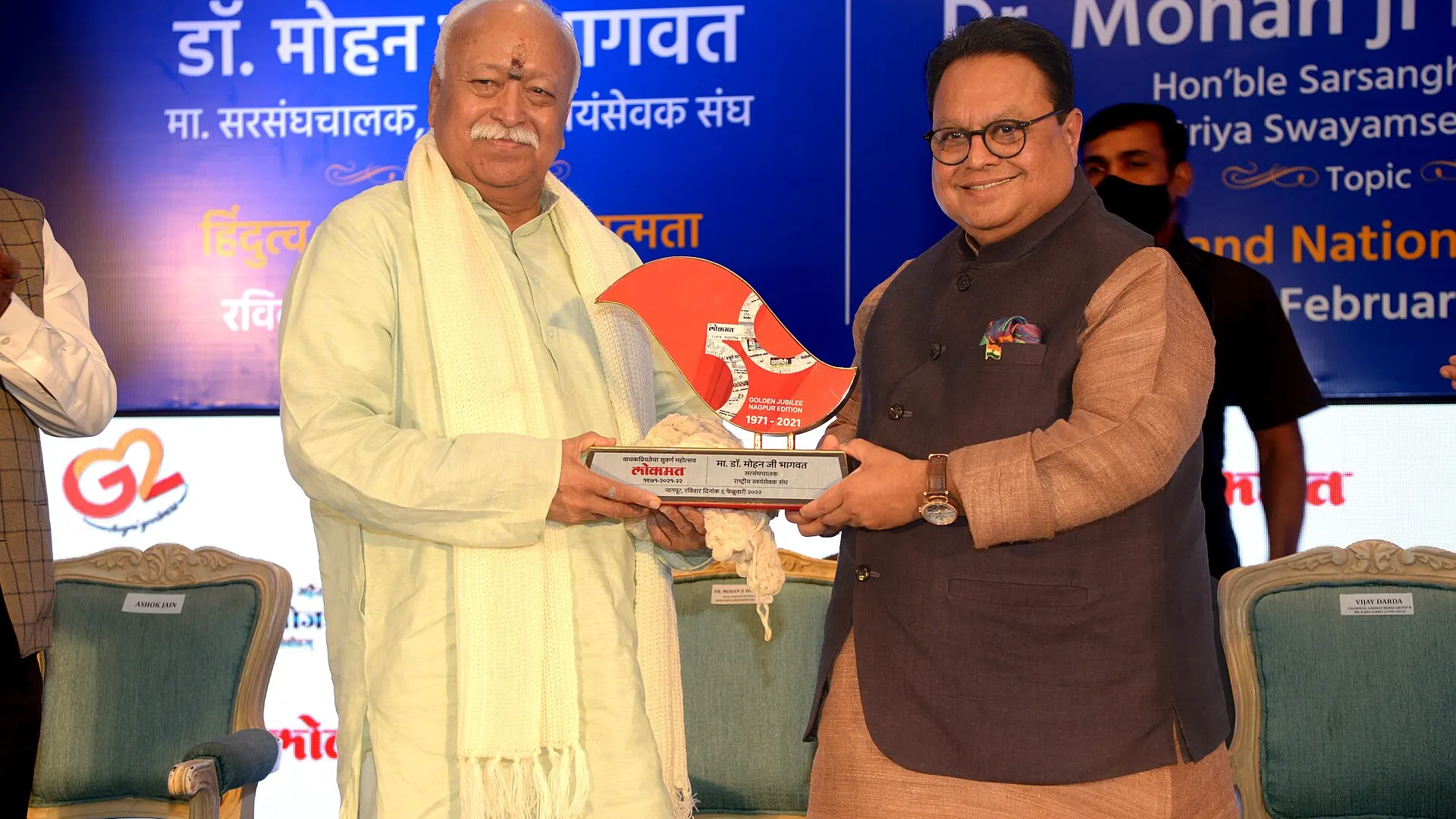
NAGPUR — Mohan Bhagwat, chief of the Hindu nationalist Rashtriya Swayamsevak Sangh (RSS), said on Tuesday that "evil forces" were trying to dismantle India and that regime change would not happen in the country, in a Vijayadashami address widely read as a response to protests over the national voter rolls.
Speaking at the group's Reshimbagh ground in Nagpur on its 101st foundation day, Bhagwat pointed to recent unrest in France and Albania and to earlier upheavals in Bangladesh and Nepal.
The RSS is the ideological parent of Prime Minister Narendra Modi's Bharatiya Janata Party (BJP), and its chief's Dussehra speech is watched closely across Indian politics. This year it came as a youth-led movement, opposition parties and student groups stage near-daily protests demanding the resignation of Chief Election Commissioner Gyanesh Kumar.
Bhagwat did not name Kumar or the protest groups. The Tribune described his references to the agitation as "oblique but evident."
"A storm has blown in from the West that opposes every form of order, propriety, auspiciousness, culture and human values, seeking to destroy, corrupt and ruin them. Even developed nations are affected by it," Bhagwat said, according to a translation by the news agency IANS.
He rejected the idea that a new government could fix a country's problems. "Look at what happened in France or Albania or Nepal or Bangladesh. They say changing the regime will change the situation. But that has never happened anywhere," he said, The Indian Express reported.
"India is their main target because India is progressing," Bhagwat said, arguing that the forces he described could not knock the country off a course set by "decisive policies in the last few decades."
He accused some Indians of helping them. "Dismantling India and the RSS is the goal of these forces and they get support even in some ambitious politicians," he said, according to The Tribune. The Hindustan Times quoted him describing such people as having "low intelligence and thirst for power."
The RSS chief said protests were a normal part of democracy but should aim at solving problems rather than winning attention. "Cheap popularity cannot be the goal of an agitation," he said.
His message on conduct was aimed at both sides of the street. "Whether it is protesting groups, authorities enforcing law and order, or political leaders, no actions should create conflict, hatred, bitterness or division within our united society," he said. "No matter how strong emotions run, our actions must stay within the boundaries of the Constitution, the law and civil decorum."
The address ranged more widely. Bhagwat repeated his call to regulate streaming platforms and social media to protect young people, said no Indian should hesitate to sing the full version of the national song Vande Mataram, and said the recent stampede deaths in Kolkata happened "because of our own fault."
Before the speech he performed the traditional worship of weapons, according to the RSS-linked weekly Organiser. The chief guest was Sanjay Gupta, editor-in-chief of the Hindi daily Dainik Jagran. Former Vice-President Jagdeep Dhankhar, Israel's consul general in Mumbai, Yaniv Revach, Maharashtra Chief Minister Devendra Fadnavis and Union minister Nitin Gadkari were among the guests, Organiser and Jagran's English site reported.
The organisation was founded in Nagpur on Vijayadashami in 1925 by Keshav Baliram Hedgewar.
The protests centre on the Special Intensive Revision, a state-by-state check of electoral rolls that has removed 130 million names. According to the Election Commission, the deletions included 28 million dead voters, 63 million who had moved away and 30 million it was unable to trace, Al Jazeera reported.
The commission rejects accusations of bias and says voters struck off in error can register again. Critics say the revision favours the BJP.
The phrase "regime change" has dominated the dispute since senior Supreme Court lawyer Prashant Bhushan said last week that the protests in Delhi had become "really a fight for regime change." Defence Minister Rajnath Singh responded by accusing groups he did not name of exploiting young people to stoke unrest, the Hindustan Times reported.
Congress lawmaker Shashi Tharoor on Monday rejected both the charge and the comparisons with Bangladesh and France that Bhagwat repeated a day later. "I think that India is not Bangladesh and India is not France. I don't see these analogies as particularly relevant," Tharoor said in Thiruvananthapuram. "What we are calling for is free and fair elections," he said.
The Cockroach Janta Party (CJP), a major force behind the protests, is meanwhile contesting the detention of two of its leaders. A Delhi court on Monday kept Ashutosh Ranka and Saurav Das in custody for two more days at the request of police, who want to question them further, Al Jazeera reported, citing Indian media.
The two were arrested last week after they and 12 other protesters got over barricades at Jantar Mantar, a long-used protest site in New Delhi, one day after it was struck off the list of permitted venues. Speaking outside the court, Ratna Singh, the CJP's legal head, called Monday's ruling "an absolute mockery of the judicial system" and said the party would appeal to a higher court.
The revision itself is moving ahead. Delhi and Karnataka are due to publish their final electoral rolls on Oct. 27 and Maharashtra, home to the RSS headquarters, on Nov. 4, under a revised schedule reported by the Press Trust of India in September.
Sources
- Mohan Bhagwat says forces trying to destabilise India: 'Regime change doesn't change circumstances' (Hindustan Times) (hindustantimes.com)
- 'Storm from West': Mohan Bhagwat says regime change will not happen in India (The Indian Express) (indianexpress.com)
- Storm from West seeking to weaken India, we must stay united: RSS chief Bhagwat on Dussehra (The Tribune) (tribuneindia.com)
- 'Regime change won't happen in India': RSS chief Mohan Bhagwat on 'storm blowing in from West' (Deccan Herald) (deccanherald.com)
- Efforts to dismantle India won't succeed, regime change won't solve problems: RSS chief (IANS, via Punjab Kesari) (english.punjabkesari.com)
- Protests Should Seek Solutions, Not Create Divisions: Sangh Chief Mohan Bhagwat At RSS Vijayadashami Event (The Daily Jagran) (thedailyjagran.com)
- RSS Vijayadashami Utsav 2026: Sangh holds grand celebrations; Sarsanghchalak Dr Mohan Bhagwat performs Shastra Pujan (Organiser) (organiser.org)
- Indian court extends detention of 'Cockroach' leaders (Al Jazeera) (aljazeera.com)
- Shashi Tharoor rejects 'regime change' charge as anti-EC protests continue (Hindustan Times) (hindustantimes.com)
- SIR phase 3: States extend deadline for final voter rolls by up to 28 days (PTI, via The Federal) (thefederal.com)
This report was compiled from the publicly available reporting listed above. Direct quotations are reproduced as published by those outlets. Corrections: see our corrections policy.