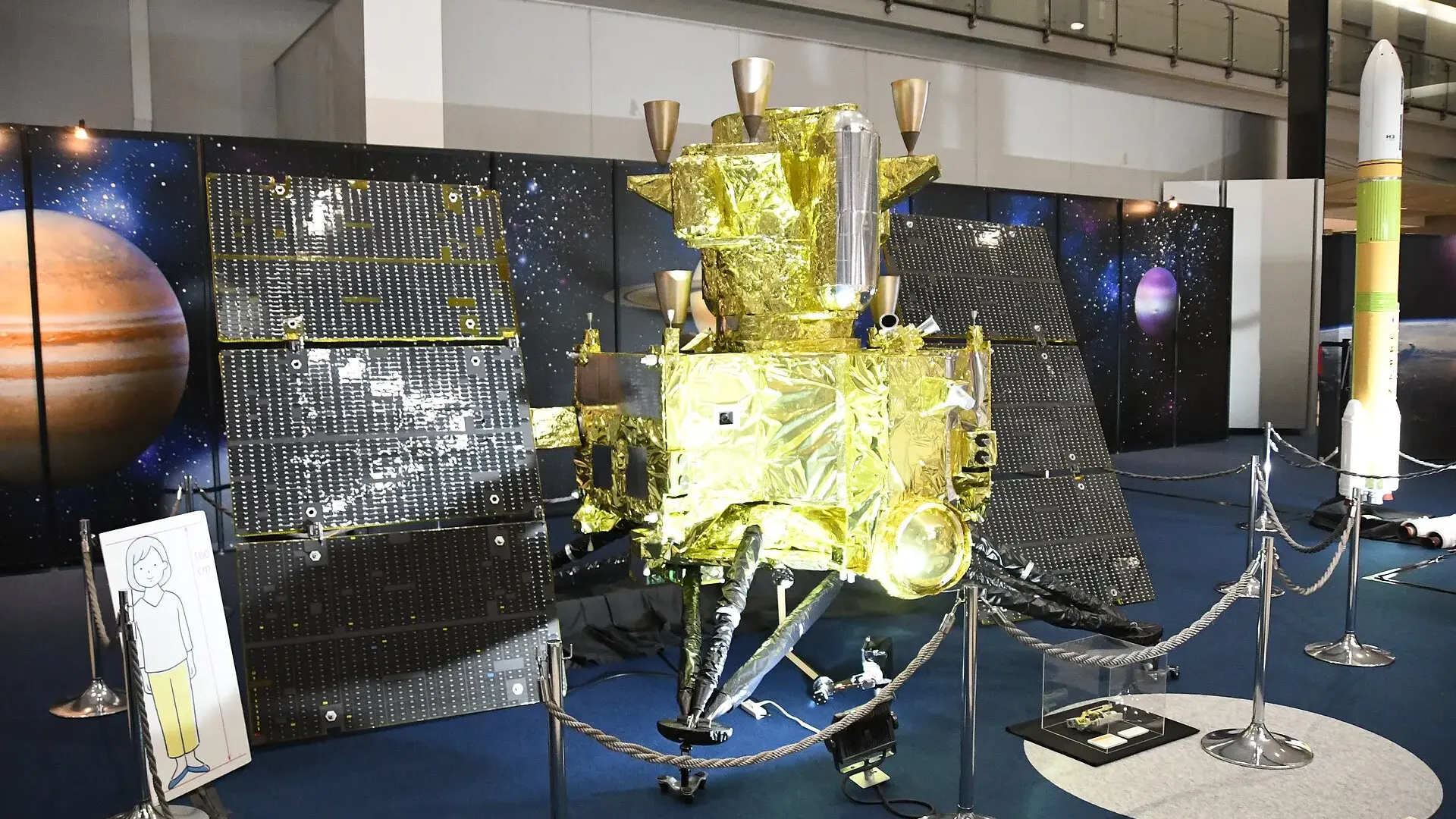
TOKYO — Japan's space agency is counting down to the launch of a spacecraft built to do something no mission has managed: land on a moon of Mars, scoop up its soil and carry it back to Earth. The Martian Moons eXploration probe, known as MMX, is scheduled to lift off on an H3 rocket from the Tanegashima Space Center in southwestern Japan at 4:41 a.m. on Tuesday local time, or 19:41 GMT on Monday, the Japan Aerospace Exploration Agency said.
If the launch goes to plan, the 4.2-tonne spacecraft will begin a five-year round trip that JAXA describes as the largest international planetary mission the country has ever led. NASA, the European Space Agency and the French and German space agencies have all supplied hardware. A return in 2031 would hand scientists the first material ever brought home from the Mars system and could settle a long-running argument about where the planet's two small moons came from.
Phobos, the larger of the pair, is a lumpy body about 22 kilometres across that circles roughly 6,000 kilometres above the Martian surface. One theory holds that it and its companion Deimos are asteroids captured by the planet's gravity. Another says they formed from debris thrown up when a large object struck Mars. Samples examined in laboratories on Earth are expected to tell the two stories apart.
"The sampling (from) Phobos is of course the world's first," Yasuhiro Kawakatsu, the MMX project manager, told AFP. He said the return leg is the hardest part. "Going deep into what we call the 'gravity well' is difficult," he said.
JAXA has brought back asteroid samples twice before. Hayabusa returned grains from the asteroid Itokawa in 2010, and Hayabusa2 delivered 5.4 grams from Ryugu in 2020.
The timeline stretches well into the next decade. MMX is due to arrive at Mars in August 2027 and settle into a close orbit around Phobos about a month later, according to ESA. In early 2029 it will release Idefix, a 25-kilogram rover built by France's CNES and Germany's DLR, which will survey the surface texture and composition to help pick a landing site. Gravity on Phobos is so weak that the rover will weigh roughly 15 grams there, ESA said.
The main spacecraft is scheduled to touch down in 2030, spending only a few hours on the surface during each of up to two landings. A robotic arm will drill a core about two centimetres deep, and a NASA-supplied backup device will blow nitrogen gas to stir up loose grains, a technique similar to the one OSIRIS-REx used at the asteroid Bennu, Astronomy magazine reported. The target is at least 10 grams of regolith.
After a flyby of Deimos, MMX will head home. Its return capsule is expected to parachute into a remote part of Australia in 2031 before being flown to Japan for curation, ESA said.
"The data and samples returned by MMX are a window to study the evolution of Mars and the Solar System," said Elliot Sefton-Nash, ESA's project scientist for the mission. Samples brought to Earth, he added, "are the gift that keeps on giving."
NASA's contributions include MEGANE, a gamma-ray and neutron spectrometer that will map the chemistry of Phobos from orbit, as well as the pneumatic sampler and 10 participating scientists, according to Astronomy. ESA supplied the deep-space transponder and power amplifier, and its Estrack antennas will relay commands and data once the probe is in flight. A French-led team built the MIRS infrared spectrometer. In all, about 20 universities and companies are involved, AFP reported.
Patrick Michel, a French astrophysicist working on the Idefix rover, told AFP that "MMX will shed light on the transport mechanisms that delivered water, volatiles, and organic compounds" to the inner planets.
The launch matters for Japan's rocket programme too. The H3, developed by JAXA and Mitsubishi Heavy Industries as the successor to the H-IIA, was destroyed on its debut flight in March 2023 after its second-stage engine failed to ignite. It failed again in December 2025, when a second-stage fault cost Japan the Michibiki 5 navigation satellite. MMX had originally been pencilled in for 2024 and slipped because of the rocket's problems. The H3 returned to flight in June and launched again in August without incident.
"Being able to be involved in such a grand mission is incredibly exciting," Makoto Arita, project manager of JAXA's H3 rocket team, told AFP.
Phobos has a long record of defeating spacecraft. The Soviet Union lost two probes bound for the moon in 1988 and 1989, and Russia's Phobos-Grunt sample-return mission failed to leave Earth orbit in 2011.
The mission also lands in the middle of a wider contest to bring back Martian material. NASA's Perseverance rover has been caching rock on the surface since 2021, but the joint NASA-ESA Mars Sample Return programme was effectively cancelled after a congressional vote in January, AFP reported. China's Tianwen-3 mission is scheduled to launch around 2028 and could return Martian samples as early as 2031, the same year MMX is due home.
JAXA will stream the launch in Japanese and English on its YouTube channel. ESA said it plans to publish confirmation of a successful launch on 20 October, after which the spacecraft faces a cruise of about a year before it reaches Mars.
Sources
- Japan to launch historic round-trip mission to Mars moons (AFP) (tribune.com.pk)
- Mars moon lander set to launch on 19 October (ESA) (esa.int)
- Japan prepares to launch sample return mission to Phobos (Astronomy) (astronomy.com)
- Japan's MMX mission aims to swipe soil samples from Mars's moon Phobos (The Conversation via Phys.org) (phys.org)
- MMX factsheet (ESA) (esa.int)
This report was compiled from the publicly available reporting listed above. Direct quotations are reproduced as published by those outlets. Corrections: see our corrections policy.