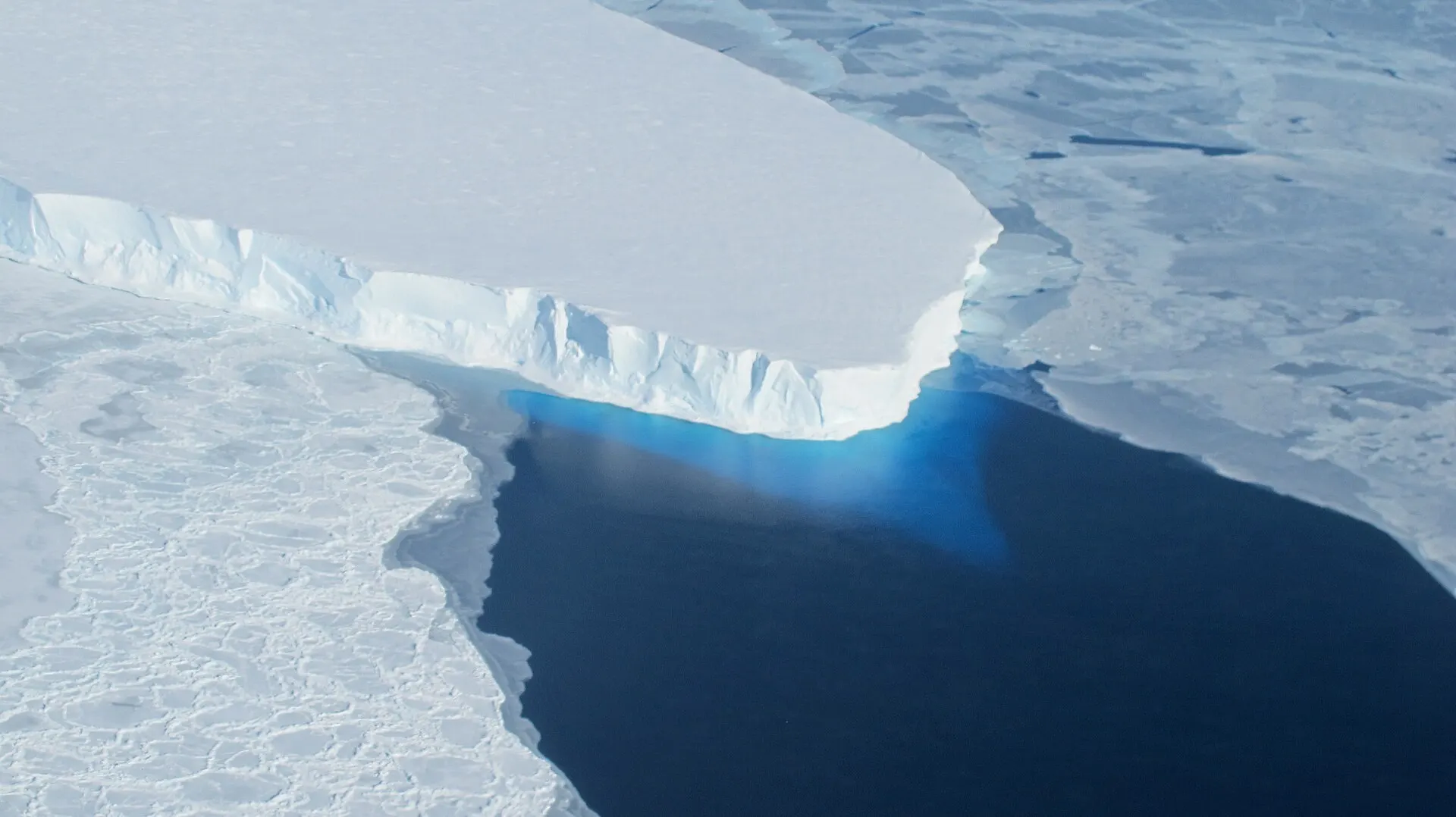
WOODS HOLE, Massachusetts — Antarctica's tallest ice cliffs break apart faster than computer models predict, but the retreat that follows is short-lived and the ice soon settles into a stable shape, according to the largest satellite survey of ice cliffs yet carried out.
The study, published on Thursday in the journal Science, tracked more than 15,000 ice cliffs along the margins of the Antarctic ice sheet between 2019 and 2023. Its authors found no evidence of the runaway collapse that some of the highest sea-level projections assume.
"We don't see this runaway effect," Caroline Needell, a doctoral student in the MIT-WHOI Joint Program and the paper's lead author, told MIT News.
The findings bear on one of the biggest uncertainties in forecasting how much the oceans will rise this century. A theory known as marine ice cliff instability holds that once a cliff rises more than about 100 metres above the waterline, the ice behind it cannot support its own weight. The cliff collapses, exposing an even taller one, which collapses in turn, in a cascade that could drain parts of the ice sheet far faster than melting alone.
Global sea level has risen more than eight inches since 1880, according to the Woods Hole Oceanographic Institution, which co-led the work, and it is projected to keep rising this century. How much depends in large part on Antarctica.
Needell and her colleagues used satellite laser altimetry, which times laser pulses bounced off the surface to measure its elevation, to gather 15,330 observations of cliff fronts every three months over four years. They compared cliff height with ice thickness, water depth, crevassing and the rate at which ice broke away.
Most cliffs were nowhere near the theoretical danger zone. The average height was about 30 metres, and the tallest the team recorded stood 127 metres above the water.
In the four regions with the tallest cliffs, the ice did collapse and retreat, and it did so faster than models of cliff instability had predicted. "Our findings suggest ice-sheet models may underestimate how quickly tall ice cliffs can break apart," Needell said in a statement released by WHOI.
But the retreat did not continue. Taller cliffs thinned quickly and settled into shorter, more stable forms, the researchers found, and the glaciers tended to pull back into positions where conditions no longer favoured rapid loss.
Height, the team concluded, is not the only thing that decides whether a cliff stands or falls. Thick melange, the jumble of broken icebergs and sea ice that packs against a glacier front, was associated with cliffs that stayed in place. Deeper water helped buoy the ice. Where bedrock rises beneath a glacier, it acts as a kind of speed bump, thinning the ice above it and lowering the risk of collapse.
"Now we know what to look for," Needell told MIT News.
Jeremy Bassis, a geophysicist at the University of Michigan and a co-author, said the pattern was consistent across the dataset. "All of the examples we have so far suggest that the rapid retreat documented in this study is short-lived," he said. He added that it is not known whether that will remain true as climate change pushes the ice sheets further from the conditions observed so far.
Catherine Walker, a glaciologist at WHOI and a co-author, said the observations could help separate the conditions that drive rapid ice loss from those that limit it. "Understanding how ice sheets lose mass is key to improving projections of future sea level rise," she said.
The marine ice cliff instability hypothesis has been debated since it was introduced into ice-sheet models about a decade ago, and later modelling studies have questioned whether it could take hold this century. Until now, there were few direct observations of how real cliffs behave at scale.
Rising temperatures are causing ice shelves to melt and calve at record rates, exposing more cliffs, MIT News reported. Faster-than-modelled retreat would mean more ice reaching the ocean. But the researchers said the short-lived nature of that retreat suggests the overall effect may be less severe than feared.
The dataset can now be used to test ice-sheet models against real-world measurements, WHOI said. The work was funded by the US National Science Foundation, NASA, the US Department of Energy, Britain's Natural Environment Research Council and the DOMINOS project, part of the International Thwaites Glacier Collaboration, which studies the West Antarctic glacier considered most vulnerable to rapid retreat.
The team's next steps are to obtain better maps of the bedrock beneath the ice and measurements of how fast it is thinning, data they say are needed before cliff collapse can be represented properly in the models used for sea-level projections.
Sources
- Satellite data reveal how Antarctica's ice cliffs behave over time (news.mit.edu)
- Global survey sheds light on the forces shaping ice-sheet stability (eurekalert.org)
- Empirical constraints on ice-cliff calving (Science) (science.org)
- Glacier cliffs break into sea faster than predicted, but restabilize (news.engin.umich.edu)
This report was compiled from the publicly available reporting listed above. Direct quotations are reproduced as published by those outlets. Corrections: see our corrections policy.